Definition
In graph theory, a clustering coefficient is a measure of the degree to which nodes in a graph tend to cluster together.
Evidence suggests that in most real-world networks, and in particular social networks, nodes tend to create tightly knit groups characterised by a relatively high density of connections; this likelihood tends to be greater than the average probability. of a tie randomly established between two nodes.
Types of Clustering Coefficients
There are two types of Clustering Coefficients:
- Global Clustering Coefficient
- Local Clustering Coefficient
- Average Clustering Coefficient
Global Clustering Coefficient
The Global Clustering Coefficient is based on triplets of nodes:
A triplet is defined as an undirected three nodes connected by:
either two (open triplet) or three (closed triplet)
∴ A triangle graph includes:
- three closed triplets, one centered on each of the nodes.
-- the three triplets in a triangle is dervied from overlapping selections of nodes.
This measure gives an indication of the clustering in the entire network (global)
It is also applicable to directed networks or transitivity
number of closed triplets
C =
__________________________________________
total number of triplets (open & closed)
The number of closed triplets also referred to as 3 × triangles △ .
A generalisation to weighted network and a redefinition to two-mode network.
3x number of ʳ
C = _______________________________
total number of triplets
Definition by Example
clustering coefficient of the 🔵 is computed as the proportion of connections among its neighbours which are actually realised compared with the number of all possible connections.
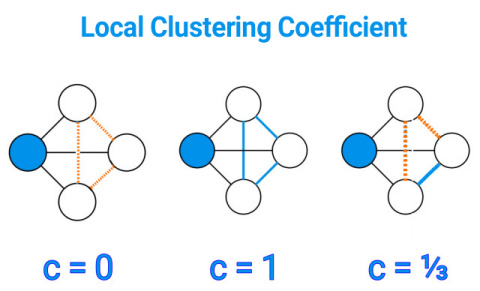
center: the 🔵 has 3 neighbours, hence it can have a maximum of 3 connections
as indicated by the 3 blue solid lines,
hence local clustering coefficient = 1
right: the 🔵 has only 1 connection realised as indicated by the 1 blue solid lines, and & the other 2 missing connections as indicated by 2 orange dotted lines, hence local clustering coefficient = ⅓
left: none of the possible connections among the neighbours of the 🔵 are realised, as indicated by the 3 orange dotted lines, hence local clustering coefficient = 0
Definition
The Local Clustering Coefficient of a vertex (node) in a graph quantifies the closeness of its neighbours are to being a clique viz: a complete graph
A graph G =(V, E) is defined as a set of vertices V & a set of edges E between these vertices.
An edge, e ij connects vertex vi with vj
ki = number of vertices
|Ni|, in the neighborhood Ni, of a vertex vi
The neighbourhood, Nij for a vertex vi is defined as its immediate connected neighbors as:
N i = { vj: eij∊E ∨ eji∊E}
The Local Clustering Coefficient, Ci, in the neighbourhood, of a vertex vi :
proportion of links between the vertices within its neighbourhood
Ci= ___________________________________________________________________
number of links that could possibly exist between them
Undirected Graph
In an undirected graph, eij≡eji ki(ki-1)
If a vertex vi has
ki neighbors &
__________ edges
2
∴ the Local Clustering Coefficient, Ci
2|{ ejk: vj, vk∊Ni, ∨ eji∊E}|
Ci= ________________________________________
ki(ki-1)
Directed Graph
directed graph, is a distinct form, whereby: ∴ ∨ neighbourhood links, ∵ among the vertices within the neighbourhood = the number of neighbours of a vertex.
In a directed graph, eij≠eji
∨ neighborhood Ni ∃ ki(ki -1) links ∀ vertices in that neighborhood.
∴ the Local Clustering Coefficient, Ci
|{ ejk: vj, vk∊Ni, ∨ eji∊E}|
Average Clustering Coefficient
As an alternative to Global Clustering Coefficient, the overall level of clustering in a network can also be measured by the average of the Local Clustering Coefficients of all the vertices n
1 n
Ci= ______________________________________
kI(kI-1)
C=__∑Ci
n i=1
-
a complete graph is a simple undirected graph in which every pair of distinct vertices is connected by a unique edge.
A complete digraph is a directed graph in which every pair of distinct vertices is connected
by a pair of unique edges (one in each direction)