Harmonice Mundi
Latin:The Harmony of the World
by Johannes Kepler
1619
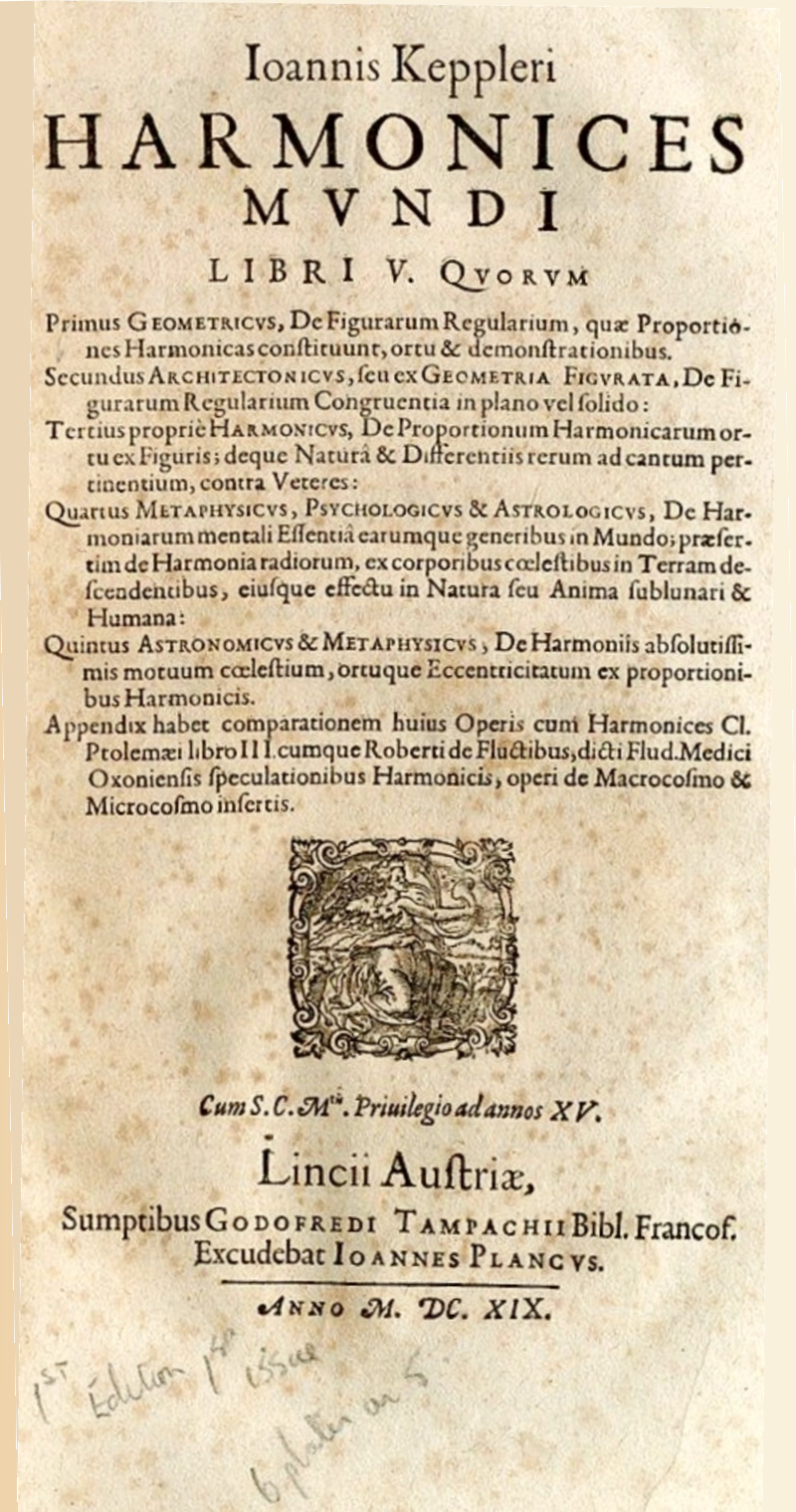
Johannes Kepler
Harmonice Mundi
is a book written entirely in Latin, where Kepler discusses harmony & congruence in geometrical forms and physical phenomena.
There is the earliest mathematical understanding of two types of regular star polyhedra, commonly referred to as Kepler's solids or Kepler Polyhedra, viz:
⭐ the small stellated dodecahedron
⭐ the great stellated dodecahedron
The concept of musical harmonies intrinsically existing within the spacing of the planets existed in medieval philosophy prior to Kepler, i.e. Musica universalis
While medieval philosophers spoke metaphorically of the music of the spheres
Kepler discovered physical harmonies in planetary motion:
where the difference between the maximum and minimum angular speeds of a planet in its orbit approximates a harmonic proportion.
The final section of the work relates his discovery of
3rd law of planetary motion
which shows a constant proportionality between the cube of the semi-major axis of a planet's orbit and the square of the time of its orbital period with relation to astronomical explanations.
The full title of the book is Harmonices mundi libri V
The Five Books of The Harmony of the World
which is commonly but ungrammatically shortened to Harmonices Mundi
1
2
3
4
K
V